Recently, I watched some interesting reviews of the Star Wars prequels. The link is here, and I highly advise checking it out. It's pretty crazy the things that they point out, such as the LACK OF A MAIN CHARACTER and LACK OF PLOT DETAILS and LIGHTSABERS ALL OVER THE ****ING PLACE. This was pretty disturbing to see on its own, but it got me thinking about the Blackest Night event and just Geoff Johns' recent work in general.
The main character of Blackest Night and the Green Lantern series isn't too much of a problem, given as the main series of GL has Hal Jordan, you know, The Green Lantern. John Stewart gets a little playtime too, but generally Hal has main billing. However, after Hal gets spirited away by Indigo-1 we have a split where the Atom and Mera are doing stuff and become protagonists of their own stories. This crossover has like 14 different protagonists derpin around until they all meet up in Coast City, where the white entity is conveniently located.
The whole entity-spectrum thing is pretty bogus too. I mean, it is a good way to make it so that Hal isn't responsible for that whole MURDERING THE GREEN LANTERN CORPS thing, but the constant use of these entities and how Parallax has to weasel his way into everyone. Ganthet gets it, Kyle get it, Hal gets it again, and in a recent issue Barry Allen gets it. Now that everyone has an entity who gives a damn about it. They're like the friggin' Pokemon of the DCU where everyone wants to collect them all so that they can get the legendary white entity.
Now, the entities are just sort of there. The real thing here is the emotional spectrum. This little thing gets thrown in there and raises a few eyebrows. I can get behind a Green Lantern having enough willpower to create constructs and such with their ring. That's pretty cool. The emotional spectrum though makes less and less sense the more I think about it.
Lets break it down real quick. Fear I can accept because they already have parallax and sinestro so whatever lets move on. The Zamaronians and the Star Sapphires also appeared earlier so that also I guess is acceptable. I don't like the fact that they felt it necessary to include the skeletons of Hawkgirl and Hawkman as their power source because that makes absolutely no sense at all. Now, the blue lanterns only get introduced because of the red lanterns, and the orange lantern is just comic relief. The indigo tribe serves solely as a vehicle for the plot. That's it.
Another thing I don't like is how the red and yellow lanterns are all weird looking and scary and stuff. They are all alien and sort of scarifying because Geoff Johns is going with the general idea of what should scare us. All these things have odd numbers of mouths and limbs and stuff or are different colors. I think the use of lolscarymonsters takes away from the actual fear. The reason the Joker is scary is because he is an unpredictable sociopath who kills for fun. He is a unique and horrifying concept because he is a total wild card. But, you see all the crazy crap the red lanterns and Sinestro corps throw out and it barely phases anyone. One psychopath is scary. A whole army of them takes away from the uniqueness of the psychopath and just makes it a bunch of token bad guys for the GLC to kill (they can do that now because it's EXTREME) without any real sort of interesting emotion (even though the whole series is supposed to be about emotion apparently). The Red lanterns also have a cat. Yeah. Just this normal cat who got mad and now has a red ring on his tail. This would be interesting if it wasn't stupid. I know exactly why Geoff added the cat. He went on the internet and saw people making jokes about cats and decided to put one in the Red Lanterns because LOL I CAN HAZ CHEEZBURGR. I could care less that there is a mad cat who has the powers of mad. It is minimally important in the grand scheme of things. It's just a cheap joke that subtracts from any sort of drama.
Speaking of cheap jokes, Geoff Johns has a very distinct style where he feels the need to insert lots of them. Whenever we have some sort of dramatic buildup or tension it's instantly kicked in the teeth by Hal cracking a joke about how Larfleeze looks like Gonzo or something. Also, the surplus of cluttered splash pages takes away from the power a splash page can have. It stops being cool really fast.
Another thing with the bigger splash pages is that they often feature like 8000 lanterns all slinging their rings around. I thought being a lantern was like this unique thing but apparently there are literally thousands of them. There are at least 3600 green lanterns alone, and seeing them all on one page makes it seem so incredibly commonplace. It's like the lightsabers in the new star wars. We see them all the time. It's like they're a price for some universal sweepstakes or when somebody buys the deluxe edition of Green Lantern: Rebirth, (or a Blackest Night tie-in at their local comic book store). Yeah, the epic battle scenes are kinda cool, but the more lanterns I see the less I care about them. I already have 4 from earth to care about and I really don't need more.
There are a few more comparisons I can make with the Star Wars prequels. One- the forced relationship with Padme and Anakin alongside Carol and Hal. Anakin and Padme are just two sort of attractive people who up and decide they are in love, or really, Anakin decides they are in love and Padme goes along with it for some reason. Carol and Hal at least have a history, but Hal has been with Cowgirl (who has not shown up in a while, by the way) for a decent amount of time. but then, Hal and Carol sort of kiss in Blackest Night for some reason and we're just supposed to accept it because they are supposed to be together. I mean, they are one of those comic book couples but not in the way Clark and Lois are. They have had more ups and downs than practically anyone. Don't force relationships because that's how it was in the Silver Age.
Speaking of Silver Age, Geoff Johns brings it all back. He brings back all these heroes and just sort of re-establishes a new silver age. I mean, I guess that's cool. It's just that these guys have had their stories told and it'd be nice to get some new ones.
Also, there's this part in the reviews I linked when they talk about how Yoda, the wise and powerful mystic decides to become a flippy swordsman. This is the same as Ganthet, wise guardian of the universe, becomes a regular Green Lantern and ringslings, even though he really doesn't need to. He has been displayed as being able to "crack a planet in half with a though" without a little ring. But then he activates the ring duplication power and adds to the ring overload even more.
There is a lot more I can talk about, and it gets worse with brightest day. I feel like Geoff needs a break or something. I don't see any substance in his work anymore. It just seems like he is an overzealous fanboy who nobody has put a leash on. Let him take a break from making everything SO EPIC and trying to tell the most important story, and just let the man be for a bit, then maybe we'll get something good. Meanwhile, I'm going to read Grant Morrison and wait until this whole thing calms down.
Showing posts with label Geoff Johns. Show all posts
Showing posts with label Geoff Johns. Show all posts
Friday, December 24, 2010


Thursday, August 5, 2010
Brightest Day #7
In a nutshell: better, but not there yet.
It's making progress, now that a connecting plot has been revealed (or at least the semblance of one) other than YOU'RE ALL ALIVE. It still seems incredibly convoluted and confusing, since it is multiple plots driven by multiple characters in different directions. In Blackest Night there was a specific focus on the various lanterns and people who would become lanterns, so two groups which reconnected in the middle of the story. Here it's still all over the place. There's a while left to get the story together, but I'm wanting that sooner than later.
Anyway, it's marked improvement, and once the series is complete I'm sure it will be fantastic. I'm just waiting for a conclusion sooner rather than later.
Tuesday, August 3, 2010
What's Wrong With Brightest Day
Brightest Day #7 comes out tomorrow, and I've been thinking about the series a lot.
I don't like it that much. I hate saying that, but it's disjointed, confusing, and has the bad habit of not answering questions but simply raising more. Here's the summary for #7.
I don't like it that much. I hate saying that, but it's disjointed, confusing, and has the bad habit of not answering questions but simply raising more. Here's the summary for #7.
"There can be only one who wields the White Lantern...but is it truly Deadman? And what will happen when he attempts to charge the white ring? Meanwhile, Ronnie Raymond risks everything for Firestorm, Martian Manhunter uncovers more clues about the bizarre string of murders stretching across the country, Aquaman searches for the key to the ocean's survival and the Hawks come face-to-face with the evil that lurks within the strange land known only as Hawkworld!"
Keep in mind there are only 32 pages there. 32 pages for 5 different storylines. That is abysmal. I want answers. I want progress. There's barely any overlap to call this a crossover. The brightest day series has just been a disappointment so far. I want to eat my words bad, but I'm doubting that it's going to get better.
Sunday, July 25, 2010
A Very Blackest Night Retrospective
Blackest Night was one of the first things I ever read in the DCU. It's a great story, provided you started with Green Lantern: Rebirth, because that's where it all begins. This story has been in motion since 2004, and has just now ended. It really is a great saga, encompassing 50+ issues, plus the Green Lantern Corps series and crossover in Blackest Night. In short. It's a lot.
The problem with Blackest Night is the uncertainty of it. I'm not sure exactly at what level of Armageddon this is. Sure, Nekron might be obliteration all life, but it doesn't seem like he has a very good reason or thesis statement or really a good plan to do so. It seems like he's just gotten fed up with things existing and wants to do something. He's like the Grinch who stole corpses (and then proceded to terrorize Whoville with a zombie army).
It is nowhere near the crisis level of Final Crisis in which the entire multiverse is dragged into oblivion by evil gods and vampiric monitors who leech of the bleed between dimensions. It pretty much involves time dissolving into a singularity in which nothing exists but Darkseid.
Yeah.
 Blackest Night just feels like an aftermath in the wake of Final Crisis. Barely any time has passed since FC and Barry Allen has come back. I guess Barry's rebirth is the trigger here, because Nekron is rather pissed about it. To sum things up he's just angry and has zombies. I honestly still don't understand why he allowed resurrections in the first place if he's so anti-life.
I think the message here is that life is hard and but that if you want to truly live you have to fight, but that was the message of Final Crisis. Blackest Night is great for the art and the spectacular full-page displays, but it lacks any actual meaning. The last issue does have some very good points and is quite quotable, but overall it's more of a massive fanboy moment than anything.
There's nothing wrong with that, but Final Crisis and Grant Morrison do a better job of meaning and metaphysics than Geoff. Geoff Johns is a good writer and his whole GL series has been great, but when it comes to dialog he's better with quips and one-liners than moving emotional words.
In short, Blackest Night is great and an important part of the GL mythos, but if you don't care for Hal Jordan, or Geoff Johns, stay away. It's a fun read but a lot of the actual power (which there is) is hidden beneath layers of combat and zombies.
Wednesday, June 16, 2010
Brightest Day #4

First off, the title is a lie. I read the whole thing and not once did I see Black Lantern Firestorm, just Ronnie Raymond passed out drunk in contrast to Jason passed out studying. I know this is all building somewhere, but this storyline has the attention span of a hummingbird.
So- things that are happening [spoilers]
-Deadman is getting jerked around by a white ring
-Aquaman is summoning dead sea life
-Ronnie killed Jasons girlfriend while he was a Black Lantern
-Martian Manhunter is not alone
-Hawk is angry (suprise, suprise)
-And Hawkman and Hawkgirl are embroiled in some weird plot with their arch-foe and are now on Pandora or something (complete with hovering rocks)
That's a lot to follow, and not a lot gets covered every issue. Blackest Night had an obvious thesis statement: Zombies and how to kill them with emotion-powers. This is just, well, confusing. I guess the heroes are confused and if Geoff is trying to recreate that for us, good job, but it's not the good type of confusion where I'm worried and wondering what will happen to characters or anything. I just want answers so we can move on.
Brightest Day #4 is good but nothing special. I've not really been disappointed with anything in this arc except the lack of focus. It just keeps bouncing from cliffhanger to cliffhanger with little actual progression save people getting more and more confused and leaving me with and confounded look on my face. I am interested to see where this goes and how it all fits together, but I'm still wondering how they are going to wrap this up in a nice big bow. Blackest Night was good in the sense that it slowly revealed things and had a discernible dramatic structure. There was action and a climax a resolution. Brightest Day just sort of feels like a denouement where everyone is standing around awkwardly standing around wondering what to do.
It's been 4 issues and nothing has really happened in terms of rising action. I'm going to keep reading because I'm already halfway in and I want to know what's going on, and if I don't keep up I'm going to be way out of the loop, but I'd be really happy if Geoff would get to it already.
In short- buy it if you like DC comics and knowing what's going on. It's nice vignettes that may one day become a full fledged story. It's going to get there. I hope.
Wednesday, May 19, 2010
Yo, Bruce Wayne, I'm really happy for you and I'ma let you finish, but Green Arrow had one of the best rebirths of all time.
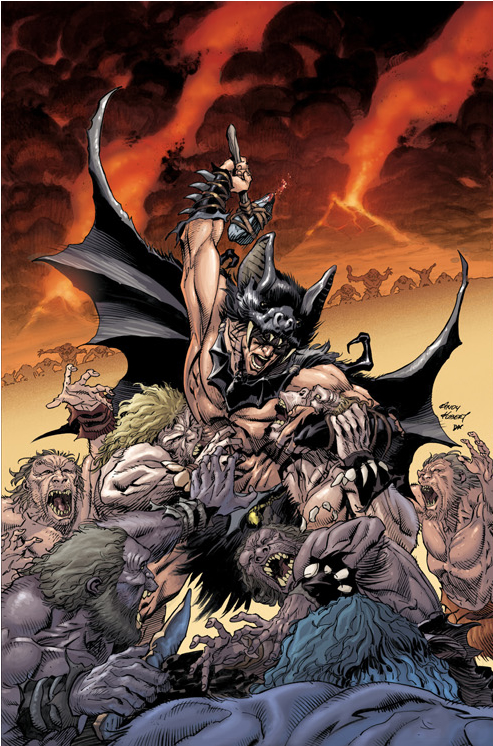
I recently picked up a copy of The Return of Bruce Wayne, which was awesome. Cave-Batman descending on a few marauding archaic Homo Sapiens with a suit made out of a giant bat is one of the funniest things I've seen in comics. I'm not against Bruce coming back. I think this is a great storyline. However, I just think we've seen enough of the rebirth stuff.
People die in comics all the time, but when a hero dies it's always big news. The Death of Superman was one of the best selling comics of the 90s. People who didn't care about comics were actually interested, which is exactly why DC chose to kill off their flagship character. Granted, he was back in a matter of months (and still with that horrible mullet) but the point was that he died. For the record, the storyline wasn't even that good. Superman and Doomsday just kind of beat up on each other until they both collapse in the ruins of Metropolis (insurance premiums must be terrible there).
There are much better deaths in comics. Barry Allen runs himself to death destroying the Anti-Monitor's cannon. Hal Jordan redeems his actions as Parallax by reigniting the sun. Captain America gets shot by a sniper for his part in the Civil War. Even Sue Dibny, the wife of the second-string hero Elongated Man, has a more meaningful death than Superman. For the record, Bruce didn't technically die, his consciousness just got blasted into prehistory, but I call it as close enough since all his friends thought he was dead and he was cut out of the DCU for a bit.
But, part of why Superman's death means nothing is that he came back so fast. Hal's death was pretty short-lived too, given as he became the Spectre very quickly after his passing. Captain America was back in a few years, and Buffy came back in time for a new season.
I give the most points to Barry Allen, simply because he took his time with it. He was dead for 23 years. He popped in and out of reality every so often, helping Bart imprison Superboy-Prime, but he stayed dead. Corporeal Barry Allen was a non-entity, and life moved on around him. His wife lived on and so did his friends, which made it even more awesome when he came back. People weren't used to heroes dying and coming back, unlike in the modern age when, during the funeral of the Martian Manhunter, Superman actually says, "and pray for a resurrection." That right there takes a lot out of the idea of heroes coming back.
Coming back to life shouldn't be commonplace. In Blackest Night #8 a plethora of dead heroes and villains magically appear thanks to the white light. Most of these people have not even been dead 5 years, with the exception of Deadman who's superpower was, well, being dead. Barry waited 23 years and then came back like a champion, running out of the speed force. People were excited by that. The whole "live" thing was cool, but that was mostly because of the 4 page spread.
Granted, Blackest Night was supposed to be all about death and resurrection and the emotional sides of our heroes ending with a retcon of the creation story, so resurrections were expected. At the end, everyone was looking around for Sue and Elongated Man, who were nowhere to be found (probably due to their bodies being disintegrated by Indigo-1). I was really happy that they didn't come back. For one, nobody really cared about them before Identity Crisis, and two it would have cheapened their death. Even if there had been some lovely Star-Sapphire based resurrection, it still would have been hollow. They were better characters dead.
A lot of people died and came back in Blackest Night. Kyle Rayner dies in GLC 42 and is back in 43. The love-based resurrection is a nice touch there, only because it solidifies his and Soranik's bond, but still, he's dead for maybe a minute total before he pops back to life.
What I guess I'm getting at is that death doesn't really mean anything anymore. It doesn't matter to readers, and it barely means anything in-universe. People shrug off death like it's nothing because they know they are going to come back. There used to be a quote, "Nobody stays dead except for Uncle Ben and Bucky".
Bucky was resurrected in 2005. Stay tuned for Ben Parker: Rebirth.
People die in comics all the time, but when a hero dies it's always big news. The Death of Superman was one of the best selling comics of the 90s. People who didn't care about comics were actually interested, which is exactly why DC chose to kill off their flagship character. Granted, he was back in a matter of months (and still with that horrible mullet) but the point was that he died. For the record, the storyline wasn't even that good. Superman and Doomsday just kind of beat up on each other until they both collapse in the ruins of Metropolis (insurance premiums must be terrible there).


There are much better deaths in comics. Barry Allen runs himself to death destroying the Anti-Monitor's cannon. Hal Jordan redeems his actions as Parallax by reigniting the sun. Captain America gets shot by a sniper for his part in the Civil War. Even Sue Dibny, the wife of the second-string hero Elongated Man, has a more meaningful death than Superman. For the record, Bruce didn't technically die, his consciousness just got blasted into prehistory, but I call it as close enough since all his friends thought he was dead and he was cut out of the DCU for a bit.
But, part of why Superman's death means nothing is that he came back so fast. Hal's death was pretty short-lived too, given as he became the Spectre very quickly after his passing. Captain America was back in a few years, and Buffy came back in time for a new season.
I give the most points to Barry Allen, simply because he took his time with it. He was dead for 23 years. He popped in and out of reality every so often, helping Bart imprison Superboy-Prime, but he stayed dead. Corporeal Barry Allen was a non-entity, and life moved on around him. His wife lived on and so did his friends, which made it even more awesome when he came back. People weren't used to heroes dying and coming back, unlike in the modern age when, during the funeral of the Martian Manhunter, Superman actually says, "and pray for a resurrection." That right there takes a lot out of the idea of heroes coming back.
Coming back to life shouldn't be commonplace. In Blackest Night #8 a plethora of dead heroes and villains magically appear thanks to the white light. Most of these people have not even been dead 5 years, with the exception of Deadman who's superpower was, well, being dead. Barry waited 23 years and then came back like a champion, running out of the speed force. People were excited by that. The whole "live" thing was cool, but that was mostly because of the 4 page spread.

Granted, Blackest Night was supposed to be all about death and resurrection and the emotional sides of our heroes ending with a retcon of the creation story, so resurrections were expected. At the end, everyone was looking around for Sue and Elongated Man, who were nowhere to be found (probably due to their bodies being disintegrated by Indigo-1). I was really happy that they didn't come back. For one, nobody really cared about them before Identity Crisis, and two it would have cheapened their death. Even if there had been some lovely Star-Sapphire based resurrection, it still would have been hollow. They were better characters dead.
A lot of people died and came back in Blackest Night. Kyle Rayner dies in GLC 42 and is back in 43. The love-based resurrection is a nice touch there, only because it solidifies his and Soranik's bond, but still, he's dead for maybe a minute total before he pops back to life.
What I guess I'm getting at is that death doesn't really mean anything anymore. It doesn't matter to readers, and it barely means anything in-universe. People shrug off death like it's nothing because they know they are going to come back. There used to be a quote, "Nobody stays dead except for Uncle Ben and Bucky".
Bucky was resurrected in 2005. Stay tuned for Ben Parker: Rebirth.
Subscribe to:
Posts (Atom)