God bless you, Grant Morrision. Er, pan-dimensional hyper-being grant you favor, Grant. All-Star Superman is beautiful. That's it. That is all there is to say. I'm not going to lie. I came cross to crying. The way Superman faces the unavoidable reality of his death while still managing to be the epitome of heroism is the truest representation of Superman's character and what makes him THE Superhero.
I am moved by this work. I really am. It is a wonderful, meaningful idea that communicates the brilliant character of Superman. There are so, so many things to talk about, but at the end of the day the most important is going to be Superman. He is just so damn Super. Over the course of the run he manages to do more than I have ever seen him do, and that is why Grant Morrison does such an incredible job whenever he writes the character. He reminds us time and time again just what kind of person Superman is.
And there in lies the brilliant irony of Superman. He has all the best traits of humanity. He is brave, caring, selfless, inventive, and compassionate. He is of an entirely pure heart, despite being the most powerful being on the planet (at least in Grant's universe). He is the best of earth despite his Kryptonian heritage. There is an incredibly moving scene where Clark speaks at his fathers funeral and we can see just how he was molded by a loving family.
People always razzle Supes because of his indestructibility and lack of humanity. Superman is at his most powerful in this story yet despite this he is at his most vulnerable. He reveals his secret ID to Lois Lane, (who never believes him) and really shows his softer side despite having bulletproof skin. He isn't even hurt by Kryptonite anymore. He is like a Super-Superman.
I want to rant more but I think I'll save that for later. It's just so, so, so good. Grant Morrison, you may be insane, but you do damn good work.
I think this story carried a lot of weight for me personally because of the recent death of my Grandmother. She as so brave and so bold facing her cancer. It reminded me a lot of her.
Showing posts with label Grant Morrison. Show all posts
Showing posts with label Grant Morrison. Show all posts
Wednesday, March 23, 2011


Monday, February 21, 2011
Monsters and Morrison
So thanks to my roommate I've been on a total Hellboy kick. I had seen the movies and dabbled a little bit, but never really read anything seriously. Now I can't put it down. I also finally got around to reading some more of Grant Morrison's work outside of the mainstream, specifically The Invisibles. I'm not sure what I think about it yet. It's very good, don't get me wrong, but I'm not sure just how much I like it.
I want to go back to Hellboy. I think if anything, Mike Mignola has a gift for characterizing without actually just telling everything. One of the interesting things about comics and characters is that because of the format (few words, lots of pictures, short issues, etc) you don't just say a bunch of things about Hellboy or Hal Jordan. Comics are the epitome of the creative writing doctrine "show, don't tell". Telling is waste a space, plus with someone like Mignola who prefers to let his panels do the talking.
I can say a lot about the character of Hellboy. It's an incredibly impressive undertaking.
I want to go back to Hellboy. I think if anything, Mike Mignola has a gift for characterizing without actually just telling everything. One of the interesting things about comics and characters is that because of the format (few words, lots of pictures, short issues, etc) you don't just say a bunch of things about Hellboy or Hal Jordan. Comics are the epitome of the creative writing doctrine "show, don't tell". Telling is waste a space, plus with someone like Mignola who prefers to let his panels do the talking.
I can say a lot about the character of Hellboy. It's an incredibly impressive undertaking.
Wednesday, November 10, 2010
Knight, the Devil, and Death: Grant Morrison's incredible saga of the return of Bruce Wayne
I had a discussion with my girlfriend recently about the academic legitimacy of comic books when compared to other finer arts and literature. Let me say that I agree that while graphic novels are part of the collective monomyth and all those Jungian archetypes, they can never hold the true legitimacy of real literature because of the simple fact that they are comics. Comic books often have multiple writers and reboots, with different people establishing different ideas on how they want to see characters. That alone seperates comics into their own separate and distinct universe which allows them establish their own stories that flow with changes in culture. Comics adapt and change with society, and while they provide good mirrors to culture, establishment of canon prevents the vast majority of running superhero comics to be counted as true literature.
Comics can be critiqued through various schools. Wonder Woman has seen her share of feminist theory for sure, but the fact of the matter is that comics are just comics, and despite how people like myself dress them up for academia, they are largely inaccessible save to those who truly know the canon. And yes, there are widely acclaimed graphic novels in the academic community. Persopolis, Maus, and American Born Chinese instantly spring to mind, but these are self-contained personal stories. They could be actual books if their authors had chose to format them that way, but they chose to do them as graphic novels instead.
Comics books and graphic novels are entirely different entities. A graphic novel is exactly what it says it is: A novel with pictures. These can legitimately be called literature. Maus is just as moving as Eli Weisel's Night. However, the vast majority of superhero comics can not be held at that same literary level. It's a sad fact, but it's one we as comic fans have to deal with. The idea of comics studies seems fun, but unfortunately its a field that will never take off. It's an interesting topic, I know, but the very nature of the comic book defies literary criticism.
I write about comics because I enjoy them. I think analyzing the heroic ideals of batman or the meaning of death in comic books is fun. I am aware that I am weird. However, it's very hard to translate comics outside of their perscribed universes. You can compare Superman to Jesus or Hercules, but not to Shakespeare. Nobody in Othello had heat vision, and Romeo and Juliet were not retconned back to life. It's easy for comic fans to see parallels because all of our heroes originate from basic ideas.
Also, superhero comics today are based around canon established decades ago, meaning the writers are generally basing their stories on what they read as a kid. Geoff Johns obviously loves the silver age Justice League because they are all apparently back, and any newer hero is sadly displaced. However, we as comic book readers love when canon ties together (this will come in later). The whole genre is based on appealing to fans and attracting new readers, which is what separates superhero comics from the rest of literature. There is a fan base. It needs to be appeased and new readers need to be brought in to keep DC and Marvel floating. This commercial drive is the wedge that will forever split the mainstream comic book from graphic novels like Maus.
I say this all sadly. I'd love to spend my life writing about comics, but there is very little legitimacy. Comics are fun, but will never be fully accepted. It's something we as fans and readers need to accept, deal with, and then go back to enjoying the best publishers have to offer.
The best, of course, being Grant Morrison (finally on topic now). If there is one man who could bring a shred of academia to the comic community, it's him.
Grant (can I call you Grant?) is intelligent, and his stories play on two levels. At first, they are just exciting and fun and suspenseful, really everything a comic book needs to be enjoyable to read. However, without a decent understanding of gothic art or mythology, a large portion of his Batman and Robin and Return of Bruce Wayne is completely missed. I have so much to say about the honest-to-go masterpiece I finished today. It is, in my opinion, the best series I have ever read. Yes, Geoff Johns, I enjoyed Blackest Night, but Grant brings a hefty weight of actual intellectual content that actually makes comic books seem a bit smarter. Your zombie heroes were cool, but Grant Morrison has a grasp on the English language and culture as a whole that makes him better than really any other comic writer I have ever read.
Morrison does this incredible thing where all of his storylines come crashing together. I find myself rereading him over and over to try and catch all his references not only to other comic books but also to literature, art, and music. I cannot possibly list them all, but they are without question phenomenal. He may know everything, or is consistently on Wikipedia.
Let me give an example of this (spoilers)
Thomas Wayne AKA Dr. Hurt has been repeatedly referred to as the devil. With his mask on his shadow looks like a horned demon. He is the Devil referenced in the title of Knight, the Devil, and Death, which is a famous piece of Gothic art. At one point the Joker gives a brief monologue about a banana, and how it represents the "primal gag": The fall. He then tosses the peel on the ground. Keep this in mind.
At the end of the arc, Hurt is running away from Batman and encounters the Joker. The Joker and Hurt are not on the best of terms. Sitting on a stump, the Joker points to a gun on the ground, and says "Betcha can't reach the gun before me, gambler." Hurt races for the gun, slips on the banana peel and falls, only to be buried alive while the Joker laughs about how his plan went to Hell.
Hurt is very clearly now the Devil. He gambles and falls. The fall refers to the Devil gambling with God and being sent to Hell.
THIS IS BRILLIANT.
It is also only one of the little details that takes many rereads to notice. Anyway, it's late. Sorry about the rant at the beginning, but it's my blog so deal. Grant Morrison, If you ever read this, thank you for an amazing story. You're what's right with comics today.
In summation- If you want an example of a phenomenal superhero comic- this is it. It's canon heavy and Wikipedia will help with a lot, as well as the comicsalliance.com annotations. Without them I would have missed so much. They do great work, and the fact that there is so much information present gives credit to Morrison as a writer. The entire arc is nothing short of brilliant, and the best today's comics have to offer.
Comics can be critiqued through various schools. Wonder Woman has seen her share of feminist theory for sure, but the fact of the matter is that comics are just comics, and despite how people like myself dress them up for academia, they are largely inaccessible save to those who truly know the canon. And yes, there are widely acclaimed graphic novels in the academic community. Persopolis, Maus, and American Born Chinese instantly spring to mind, but these are self-contained personal stories. They could be actual books if their authors had chose to format them that way, but they chose to do them as graphic novels instead.
Comics books and graphic novels are entirely different entities. A graphic novel is exactly what it says it is: A novel with pictures. These can legitimately be called literature. Maus is just as moving as Eli Weisel's Night. However, the vast majority of superhero comics can not be held at that same literary level. It's a sad fact, but it's one we as comic fans have to deal with. The idea of comics studies seems fun, but unfortunately its a field that will never take off. It's an interesting topic, I know, but the very nature of the comic book defies literary criticism.
I write about comics because I enjoy them. I think analyzing the heroic ideals of batman or the meaning of death in comic books is fun. I am aware that I am weird. However, it's very hard to translate comics outside of their perscribed universes. You can compare Superman to Jesus or Hercules, but not to Shakespeare. Nobody in Othello had heat vision, and Romeo and Juliet were not retconned back to life. It's easy for comic fans to see parallels because all of our heroes originate from basic ideas.
Also, superhero comics today are based around canon established decades ago, meaning the writers are generally basing their stories on what they read as a kid. Geoff Johns obviously loves the silver age Justice League because they are all apparently back, and any newer hero is sadly displaced. However, we as comic book readers love when canon ties together (this will come in later). The whole genre is based on appealing to fans and attracting new readers, which is what separates superhero comics from the rest of literature. There is a fan base. It needs to be appeased and new readers need to be brought in to keep DC and Marvel floating. This commercial drive is the wedge that will forever split the mainstream comic book from graphic novels like Maus.
I say this all sadly. I'd love to spend my life writing about comics, but there is very little legitimacy. Comics are fun, but will never be fully accepted. It's something we as fans and readers need to accept, deal with, and then go back to enjoying the best publishers have to offer.
The best, of course, being Grant Morrison (finally on topic now). If there is one man who could bring a shred of academia to the comic community, it's him.
Grant (can I call you Grant?) is intelligent, and his stories play on two levels. At first, they are just exciting and fun and suspenseful, really everything a comic book needs to be enjoyable to read. However, without a decent understanding of gothic art or mythology, a large portion of his Batman and Robin and Return of Bruce Wayne is completely missed. I have so much to say about the honest-to-go masterpiece I finished today. It is, in my opinion, the best series I have ever read. Yes, Geoff Johns, I enjoyed Blackest Night, but Grant brings a hefty weight of actual intellectual content that actually makes comic books seem a bit smarter. Your zombie heroes were cool, but Grant Morrison has a grasp on the English language and culture as a whole that makes him better than really any other comic writer I have ever read.
Morrison does this incredible thing where all of his storylines come crashing together. I find myself rereading him over and over to try and catch all his references not only to other comic books but also to literature, art, and music. I cannot possibly list them all, but they are without question phenomenal. He may know everything, or is consistently on Wikipedia.
Let me give an example of this (spoilers)
Thomas Wayne AKA Dr. Hurt has been repeatedly referred to as the devil. With his mask on his shadow looks like a horned demon. He is the Devil referenced in the title of Knight, the Devil, and Death, which is a famous piece of Gothic art. At one point the Joker gives a brief monologue about a banana, and how it represents the "primal gag": The fall. He then tosses the peel on the ground. Keep this in mind.
At the end of the arc, Hurt is running away from Batman and encounters the Joker. The Joker and Hurt are not on the best of terms. Sitting on a stump, the Joker points to a gun on the ground, and says "Betcha can't reach the gun before me, gambler." Hurt races for the gun, slips on the banana peel and falls, only to be buried alive while the Joker laughs about how his plan went to Hell.
Hurt is very clearly now the Devil. He gambles and falls. The fall refers to the Devil gambling with God and being sent to Hell.
THIS IS BRILLIANT.
It is also only one of the little details that takes many rereads to notice. Anyway, it's late. Sorry about the rant at the beginning, but it's my blog so deal. Grant Morrison, If you ever read this, thank you for an amazing story. You're what's right with comics today.
In summation- If you want an example of a phenomenal superhero comic- this is it. It's canon heavy and Wikipedia will help with a lot, as well as the comicsalliance.com annotations. Without them I would have missed so much. They do great work, and the fact that there is so much information present gives credit to Morrison as a writer. The entire arc is nothing short of brilliant, and the best today's comics have to offer.
Thursday, October 14, 2010
Bruce is Back, Baby
Return of Bruce Wayne #5 came out this Wednesday, along with a plethora of tie-ins about his return to the present. I can't begin to talk about how much I loved this series, especially the characterization of Bruce as more than just brood and gloom and as a really whole person. By using his closest friends and allies, as well as proteges and an unknown offspring, Bruce is truly realized beyond his Dark Knight identity.
Grant Morrison is an incredibly surreal writer. He incorporates sound into his books like no other comic author I've seen. In Final Crisis, music plays a huge role. The Ultima Thule, the inter-dimensional ship used to gather up the Supermen of the multiverse, looks like the yellow submarine of Beatles fame. It is driven by what appears to be an organ and a harp. Overman (Nazi Superman) and others talk about the "great and terrible music" of the multiverse. Grant Morrison uses this overarching theme of life and the universe(s) as just vibrations combining into this music. Superman defeats Darkseid by canceling out his vibration (Darkseid, the anti-life, is cited as having "always hated music).
In Return of Bruce Wayne, there is the sound of bells echoing throughout the story. Whenever Bruce is about to the bells sound, the "Bells of the all-over". You can actually hear these frantic bells ringing, summoning Bruce to his ultimate destiny. The are like alarms, warning us of the imminent danger of Bruce's return and what crisis #6 is going to bring.
There are some new tie-ins out too, involving Red Robin, Dick, and Damien, as well as the other members of the Bat-verse (yes, I said that). These might have needed to wait a week or so because (spoiler alert), they kind of take away from the climax of #5 and #6. You'll understand if you read it. It's a must for any Batman fan.
Grant Morrison is an incredibly surreal writer. He incorporates sound into his books like no other comic author I've seen. In Final Crisis, music plays a huge role. The Ultima Thule, the inter-dimensional ship used to gather up the Supermen of the multiverse, looks like the yellow submarine of Beatles fame. It is driven by what appears to be an organ and a harp. Overman (Nazi Superman) and others talk about the "great and terrible music" of the multiverse. Grant Morrison uses this overarching theme of life and the universe(s) as just vibrations combining into this music. Superman defeats Darkseid by canceling out his vibration (Darkseid, the anti-life, is cited as having "always hated music).
In Return of Bruce Wayne, there is the sound of bells echoing throughout the story. Whenever Bruce is about to the bells sound, the "Bells of the all-over". You can actually hear these frantic bells ringing, summoning Bruce to his ultimate destiny. The are like alarms, warning us of the imminent danger of Bruce's return and what crisis #6 is going to bring.
There are some new tie-ins out too, involving Red Robin, Dick, and Damien, as well as the other members of the Bat-verse (yes, I said that). These might have needed to wait a week or so because (spoiler alert), they kind of take away from the climax of #5 and #6. You'll understand if you read it. It's a must for any Batman fan.
Monday, June 28, 2010
Final Crisis and the Triumph of the Human F$@#ing Spirit
I picked up a trade copy of Final Crisis at Ed Mckay's a while back. I had read it before and responded with a resounding "meh". I reread it a bit back and realized that it's actually pretty awesome.
It's much more than just CROSS OVER!!! It's a complex story about human existence and the end of all stories. This is not a bunch of heroes running around doing cool things, but an epic about what it means to be human and life itself.
Human nature, as believed by pretty much every non human in the DC universe(s) and the monitors is to essentially be complete assholes. We are nothing but hopeless barbarians on a primitive mudball who kill each other for no good reason. Humanity and super-humanity is about rising above that primal nature, to be a beacon of hope and fight against the darkness that inhabits our hearts. The anti-life equation of Final Crisis lists the evils of humanity : prejudice, oppression, hate, and ignorance, yet we continue to fight against what is perceived as the essence of our being. Dan Turpin sums it up in Final Crisis #1, "Fire was our first mistake. Like everythin' else the sad stinkin' human race ever thought of, we take a good idea and use it to kill ourselves."
Dan Turpin is a cynic, a pessimist cop who ends up harboring the consciousness of Darkseid. He fights against anti-life, but eventually wanes ("How can I fight if there is nothing to fight for"). He gives in and Darkseid takes over. He and the 3 billion enslaved in anti-life fight against the heroes and villains resisting. Darkseid represents the easy way out. Giving in to him represents giving in to the perils of humanity and anti-life.
The only protection against anti-life is a glyph symbolizing freedom. We have the choice to be more than just hairless apes. Our will allows us to overcome our so-called nature. Even though life is hard and the world sucks a lot of the time, we can press on towards a brighter day. People have terrible, animal flaws (as seen by many evil gods taking somewhat animal forms), but to get all Talmudic for a second, "In a world where no one behaves like a human being, you must strive to be human!"
Anti-life is easy. Living is hard.God help us if we ever give up and give in. Everything ceases to be. The Final Crisis is not just Darkseid, it's the end of all stories because of the ever-constant monitors being effected by our world. The monitors, a race of pan-dimensional beings that feed on the "bleed" between universes make contact with our "germ worlds". They take on all the aspects of humanity, betraying and conspiring, but also loving and feeling. As always the negative shows up with more gusto, and two monitors fall from grace and give in to what the perceive as their nature: universal vampires. Superman, in exchange for bleed to save his dying wife, goes to fight against him alongside Ultraman, Overman, Captain Marvel, and Allen Adam (read: Dr. Manhattan with clothes).
Superman, of course, is the one who ends up fighting Mandrakk the Dark Monitor, and in a beautifully written scene, displays his undying hope and unyielding belief in the innate good. He refuses to give up on anything. He is the best we have to offer, and no matter how much cooler Batman is, Superman is the living embodiment of human good. His story is simple: that of ultimate good versus ultimate evil. He is the only one trusted with the design for the miracle machine, and uses it for the best of the universe. He wishes for a happy ending. The Final Crisis is supposed to be the end to all stories, but as Superman engraves on what was supposed to be his tombstone: To be continued.
To be continued. Earth endures. The true triumph of humanity is our persistance, that despite every crisis, every failing, every war we still endure. Grant Morrison has it right, "This world , these amazing people, have faced alien invasions, natural disasters, quakes in time. And always we recover... we rebuild... we continue. Earth endures. It's as if we don't know what else to do."
It's much more than just CROSS
 OVER!!! It's a complex story about human existence and the end of all stories. This is not a bunch of heroes running around doing cool things, but an epic about what it means to be human and life itself.
Human nature, as believed by pretty much every non human in the DC universe(s) and the monitors is to essentially be complete assholes. We are nothing but hopeless barbarians on a primitive mudball who kill each other for no good reason. Humanity and super-humanity is about rising above that primal nature, to be a beacon of hope and fight against the darkness that inhabits our hearts. The anti-life equation of Final Crisis lists the evils of humanity : prejudice, oppression, hate, and ignorance, yet we continue to fight against what is perceived as the essence of our being. Dan Turpin sums it up in Final Crisis #1, "Fire was our first mistake. Like everythin' else the sad stinkin' human race ever thought of, we take a good idea and use it to kill ourselves."
Dan Turpin is a cynic, a pessimist cop who ends up harboring the consciousness of Darkseid. He fights against anti-life, but eventually wanes ("How can I fight if there is nothing to fight for"). He gives in and Darkseid takes over. He and the 3 billion enslaved in anti-life fight against the heroes and villains resisting. Darkseid represents the easy way out. Giving in to him represents giving in to the perils of humanity and anti-life.
The only protection against anti-life is a glyph symbolizing freedom. We have the choice to be more than just hairless apes. Our will allows us to overcome our so-called nature. Even though life is hard and the world sucks a lot of the time, we can press on towards a brighter day. People have terrible, animal flaws (as seen by many evil gods taking somewhat animal forms), but to get all Talmudic for a second, "In a world where no one behaves like a human being, you must strive to be human!"
Anti-life is easy. Living is hard.God help us if we ever give up and give in. Everything ceases to be. The Final Crisis is not just Darkseid, it's the end of all stories because of the ever-constant monitors being effected by our world. The monitors, a race of pan-dimensional beings that feed on the "bleed" between universes make contact with our "germ worlds". They take on all the aspects of humanity, betraying and conspiring, but also loving and feeling. As always the negative shows up with more gusto, and two monitors fall from grace and give in to what the perceive as their nature: universal vampires. Superman, in exchange for bleed to save his dying wife, goes to fight against him alongside Ultraman, Overman, Captain Marvel, and Allen Adam (read: Dr. Manhattan with clothes).
Superman, of course, is the one who ends up fighting Mandrakk the Dark Monitor, and in a beautifully written scene, displays his undying hope and unyielding belief in the innate good. He refuses to give up on anything. He is the best we have to offer, and no matter how much cooler Batman is, Superman is the living embodiment of human good. His story is simple: that of ultimate good versus ultimate evil. He is the only one trusted with the design for the miracle machine, and uses it for the best of the universe. He wishes for a happy ending. The Final Crisis is supposed to be the end to all stories, but as Superman engraves on what was supposed to be his tombstone: To be continued.
To be continued. Earth endures. The true triumph of humanity is our persistance, that despite every crisis, every failing, every war we still endure. Grant Morrison has it right, "This world , these amazing people, have faced alien invasions, natural disasters, quakes in time. And always we recover... we rebuild... we continue. Earth endures. It's as if we don't know what else to do."
Wednesday, May 19, 2010
Yo, Bruce Wayne, I'm really happy for you and I'ma let you finish, but Green Arrow had one of the best rebirths of all time.
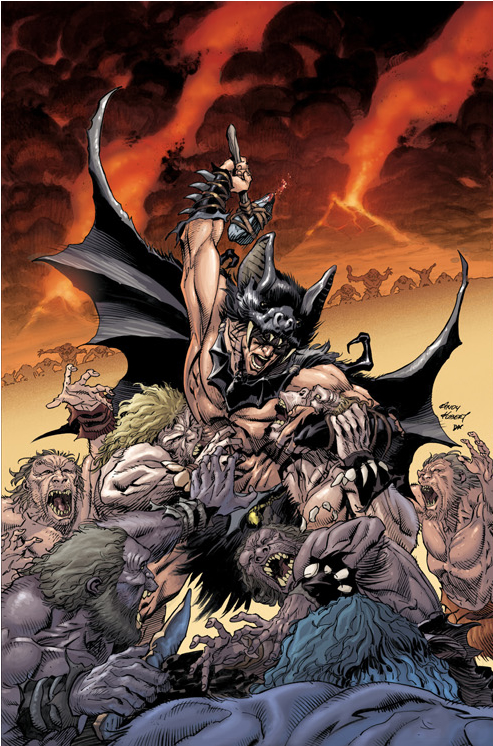
I recently picked up a copy of The Return of Bruce Wayne, which was awesome. Cave-Batman descending on a few marauding archaic Homo Sapiens with a suit made out of a giant bat is one of the funniest things I've seen in comics. I'm not against Bruce coming back. I think this is a great storyline. However, I just think we've seen enough of the rebirth stuff.
People die in comics all the time, but when a hero dies it's always big news. The Death of Superman was one of the best selling comics of the 90s. People who didn't care about comics were actually interested, which is exactly why DC chose to kill off their flagship character. Granted, he was back in a matter of months (and still with that horrible mullet) but the point was that he died. For the record, the storyline wasn't even that good. Superman and Doomsday just kind of beat up on each other until they both collapse in the ruins of Metropolis (insurance premiums must be terrible there).
There are much better deaths in comics. Barry Allen runs himself to death destroying the Anti-Monitor's cannon. Hal Jordan redeems his actions as Parallax by reigniting the sun. Captain America gets shot by a sniper for his part in the Civil War. Even Sue Dibny, the wife of the second-string hero Elongated Man, has a more meaningful death than Superman. For the record, Bruce didn't technically die, his consciousness just got blasted into prehistory, but I call it as close enough since all his friends thought he was dead and he was cut out of the DCU for a bit.
But, part of why Superman's death means nothing is that he came back so fast. Hal's death was pretty short-lived too, given as he became the Spectre very quickly after his passing. Captain America was back in a few years, and Buffy came back in time for a new season.
I give the most points to Barry Allen, simply because he took his time with it. He was dead for 23 years. He popped in and out of reality every so often, helping Bart imprison Superboy-Prime, but he stayed dead. Corporeal Barry Allen was a non-entity, and life moved on around him. His wife lived on and so did his friends, which made it even more awesome when he came back. People weren't used to heroes dying and coming back, unlike in the modern age when, during the funeral of the Martian Manhunter, Superman actually says, "and pray for a resurrection." That right there takes a lot out of the idea of heroes coming back.
Coming back to life shouldn't be commonplace. In Blackest Night #8 a plethora of dead heroes and villains magically appear thanks to the white light. Most of these people have not even been dead 5 years, with the exception of Deadman who's superpower was, well, being dead. Barry waited 23 years and then came back like a champion, running out of the speed force. People were excited by that. The whole "live" thing was cool, but that was mostly because of the 4 page spread.
Granted, Blackest Night was supposed to be all about death and resurrection and the emotional sides of our heroes ending with a retcon of the creation story, so resurrections were expected. At the end, everyone was looking around for Sue and Elongated Man, who were nowhere to be found (probably due to their bodies being disintegrated by Indigo-1). I was really happy that they didn't come back. For one, nobody really cared about them before Identity Crisis, and two it would have cheapened their death. Even if there had been some lovely Star-Sapphire based resurrection, it still would have been hollow. They were better characters dead.
A lot of people died and came back in Blackest Night. Kyle Rayner dies in GLC 42 and is back in 43. The love-based resurrection is a nice touch there, only because it solidifies his and Soranik's bond, but still, he's dead for maybe a minute total before he pops back to life.
What I guess I'm getting at is that death doesn't really mean anything anymore. It doesn't matter to readers, and it barely means anything in-universe. People shrug off death like it's nothing because they know they are going to come back. There used to be a quote, "Nobody stays dead except for Uncle Ben and Bucky".
Bucky was resurrected in 2005. Stay tuned for Ben Parker: Rebirth.
People die in comics all the time, but when a hero dies it's always big news. The Death of Superman was one of the best selling comics of the 90s. People who didn't care about comics were actually interested, which is exactly why DC chose to kill off their flagship character. Granted, he was back in a matter of months (and still with that horrible mullet) but the point was that he died. For the record, the storyline wasn't even that good. Superman and Doomsday just kind of beat up on each other until they both collapse in the ruins of Metropolis (insurance premiums must be terrible there).


There are much better deaths in comics. Barry Allen runs himself to death destroying the Anti-Monitor's cannon. Hal Jordan redeems his actions as Parallax by reigniting the sun. Captain America gets shot by a sniper for his part in the Civil War. Even Sue Dibny, the wife of the second-string hero Elongated Man, has a more meaningful death than Superman. For the record, Bruce didn't technically die, his consciousness just got blasted into prehistory, but I call it as close enough since all his friends thought he was dead and he was cut out of the DCU for a bit.
But, part of why Superman's death means nothing is that he came back so fast. Hal's death was pretty short-lived too, given as he became the Spectre very quickly after his passing. Captain America was back in a few years, and Buffy came back in time for a new season.
I give the most points to Barry Allen, simply because he took his time with it. He was dead for 23 years. He popped in and out of reality every so often, helping Bart imprison Superboy-Prime, but he stayed dead. Corporeal Barry Allen was a non-entity, and life moved on around him. His wife lived on and so did his friends, which made it even more awesome when he came back. People weren't used to heroes dying and coming back, unlike in the modern age when, during the funeral of the Martian Manhunter, Superman actually says, "and pray for a resurrection." That right there takes a lot out of the idea of heroes coming back.
Coming back to life shouldn't be commonplace. In Blackest Night #8 a plethora of dead heroes and villains magically appear thanks to the white light. Most of these people have not even been dead 5 years, with the exception of Deadman who's superpower was, well, being dead. Barry waited 23 years and then came back like a champion, running out of the speed force. People were excited by that. The whole "live" thing was cool, but that was mostly because of the 4 page spread.

Granted, Blackest Night was supposed to be all about death and resurrection and the emotional sides of our heroes ending with a retcon of the creation story, so resurrections were expected. At the end, everyone was looking around for Sue and Elongated Man, who were nowhere to be found (probably due to their bodies being disintegrated by Indigo-1). I was really happy that they didn't come back. For one, nobody really cared about them before Identity Crisis, and two it would have cheapened their death. Even if there had been some lovely Star-Sapphire based resurrection, it still would have been hollow. They were better characters dead.
A lot of people died and came back in Blackest Night. Kyle Rayner dies in GLC 42 and is back in 43. The love-based resurrection is a nice touch there, only because it solidifies his and Soranik's bond, but still, he's dead for maybe a minute total before he pops back to life.
What I guess I'm getting at is that death doesn't really mean anything anymore. It doesn't matter to readers, and it barely means anything in-universe. People shrug off death like it's nothing because they know they are going to come back. There used to be a quote, "Nobody stays dead except for Uncle Ben and Bucky".
Bucky was resurrected in 2005. Stay tuned for Ben Parker: Rebirth.
Subscribe to:
Posts (Atom)