Showing posts with label serious stuff. Show all posts

Monday, November 12, 2012

Love and Marriage (and Reboots)


            One of the most interesting things to note in all of the reboots that have taken place in that few years is the re-bachelorization of pretty much every superhero. Lois Lane is no longer Superman’s girlfriend, The Flash is no longer married, and Spider-man no longer loves Mary Jane. All of this, of course, is done with the idea that marriage ages a character and makes him or her less relatable.

            Now, while this does have a decent point, I don’t think it’s actually an accurate statement. It also says something fairly disturbing about how the (mostly male) writers view marriage and women, as well as their audience.

            In a recent issue of Superman, he quits the Daily Planet pretty much because he uses his X-Ray vision to read a text message from Lois Lane’s new man about them moving in together. Now, this version of Supes has been crazy for Lois forever but never done anything about it, and then gets mad that she’s with someone else. Now, I’ve been on the internet/in high school enough to get the concept of “The Friend Zone”, but as someone who is no longer fourteen I don’t want Superman acting like he is.

            Yes, you might make a character more relatable to one group of people, but what about the rest of us? As more and more superhero comics are made to be relatable to fourteen year-old boys and people with the mentality of same, people who aren’t are just going to stop reading them.

            I’ve had a really hard time trying to get back into the New 52 because of a lot of those choices. I hate that the Flash is unmarried and that there isn’t a “Flash Family” anymore because that dynamic made the character. Superman is kind of a prat without Lois Lane, and whenever he shacks up with Wonder Woman (as he’s done recently), he gets all moody.

            I talk a lot about how comics should be for everybody, and no comic should be more inclusive than Superman simply based on what he represents. Seeing him being your friend from high school who pined after a girl but never did anything and then got mad when she started seeing someone else is just shameful. Nobody wants to watch the world’s greatest hero act like he’s fourteen. We have enough culture already geared towards teenage boys and man-children.

            So, the solution? Honestly, we need more female writers and creators who will target a different audience. We need new voices to characters, not just new backstories. Having actual women writing will hopefully thin out the creepy stuff as well as some of the frankly misogynistic mentalities that comics have been coming out with.

            One final note: Eventually all these heroes will get remarried so what is the point of all this? Seriously. Heed my prophecies, kids.

Monday, October 22, 2012

Think of the Children!: Censorship and Taking Offense


            Censorship is a funny thing. It’s not really ha-ha funny, but there it’s something that interests me a lot. Aside from the FCC (which deals only with content on public airwaves, meaning AM and FM radio and over-the-air TV) the vast majority of American media is self-regulated. The MPAA, ESRB, and CCA are all industry based regulatory bodies who have no actual power to prevent content from being released, but do control what major stores or theaters will carry. Most theaters will not show movies rated NC-17 or that have not been approved by the MPAA, and most stores don’t sell unrated games.

            Of course, with the Internet being incredible for disseminating digital content, selling something in a store is no longer important, meaning more and more content can skirt past regulation. And while the ESRB is weak (at best) the MPAA has a lot of weight in terms of mainstream movie content. A lot of their rules are interesting and their policies on sex in cinema (especially homosexual sex) have come under a lot of scrutiny in the last decade.

            The marketplace does a phenomenal job of regulating indecency (a term that I don’t like to use but will anyway) simply because if something makes the vast majority of viewers uncomfortable, they won’t watch or play. Advertisers will pull out and the producers ultimately lose money. The only time the government will step in if it is being broadcast over the air, on networks like Fox, NBC, or ABC or on AM or FM stations. The last big to-do was the Janet Jackson wardrobe malfunction, but honestly the FCC can’t really do too much except send out fines. They may be big fines, but honestly it’s not as bad as the advertisers that would leave.

            More recently there was the Don Imus incident. He didn’t get pulled off the air by anyone, but by the market. Advertisers said they wouldn’t support him, and CBS chose to go with that.  That’s the lesson, do or say something that goes too far and people will treat you like you have the plague.

            Comics went through all of this in the ‘50s thanks to Dr. Freric Wertham and his book Seduction of the Innocent. After the book incited a moral panic and led to a congressional inquiry into the business, companies formed the Comics Code Authority, which placed draconian censorship rules on the medium and decimated the titles available, leaving mostly only superhero comics.

            Comics couldn’t even use the word “zombie”. It was bad, and it nearly destroyed comics. However, after Dr. Wertham’s panic stopped, pretty much everyone forgot about it and the code and the Comics Code Authority are no longer things. The symbol for the CCA has actually been adopted by the Comic Book Legal DefenseFund, which is a pretty great organization in the fight against censorship.

            I stand strong against censorship, and believe (like a true American) that the market will decide what is and isn’t appropriate. If most people find something offensive then it will go away simply based on backlash. If you find something really offensive and most people don’t then try and explain your point of view. Back during the summer there was the whole thing with Daniel Tosh making some rape jokes, and I’m sure a lot of boys who have grown up on X-Box live where rape is a verb of choice didn’t really see what the big deal was.  Granted, explaining anything to a 14 year old boy is damn near impossible, but they need to get it sooner or later.

            However, sometimes if something offends you it may be just you (this does not include rape jokes, those are not cool, just making that clear) . There’s a group out there called One Million Moms, which is a part of the American Family Association. They are awful. They have a serious problem with gay people, calling for boycotts of everything from Glee to Friggin’ Archie Comics, mostly for featuring homosexual characters. When you’re offended by Archie, that’s the time to reconsider your life.

            America is meant to be a place of tolerance for our fellow man/woman/dog regardless of who they are. A lot of people think this means we have to tolerate offensive humor, but they’re wrong. One of the most interesting things about American culture is how we slowly come to national terms about what’s acceptable. If someone does something uncool with the majority they get punished for it in the most American place they can: the wallet.

            After OMM made their statements about a gay wedding in Life with Archie #16, CEO John Goldwater responded with this:

"We stand by Life with Archie #16. As I've said before, Riverdale is a safe, welcoming place that does not judge anyone. It's an idealized version of America that will hopefully become reality someday.

We're sorry the American Family Association/OneMillionMoms.com feels so negatively about our product, but they have every right to their opinion, just like we have the right to stand by ours. Kevin Keller will forever be a part of Riverdale, and he will live a happy, long life free of prejudice, hate and narrow-minded people."


America. F$#% yeah.


Thursday, October 11, 2012

War Stories: How do we handle war in entertainment?


            War comics used to be a big part of overall comics titles. Blackhawk, Sergeant Rock, and Sgt. Fury and His Howling Commandos (which should sound pretty familiar given Nick Fury’s resurgence and the Howling Commandos’ appearance in the Captain America movie) were all popular titles, yet they have fallen by the wayside in modern comics. Curious about this, I went on Marvel and DC’s websites but I couldn’t find any war comics. DC had brought back titles like Men of War, Blackhawk, and G.I. Combat but all of them have already been cancelled.
           
            Of course, most of these comics had already gone away around the same time in the ‘70s and ‘80s. Audiences weren’t engaged with them anymore. Blackhawk was revamped in possibly the worst reboot of all time. Most of these comics faded away with the new prevalence of TV reporting in Vietnam showing Americans the real face of war every night. War comics fell by the wayside.


Seriously. Look at this nonsense.

            That said, I’m not sure why DC brought back these titles in the New 52, but I have a pretty good idea why these comics were cancelled (again).When comics are cancelled it’s simply because they aren’t selling. Serious comics about war are hard to sell to comics target market. A serious and mature war comic like Blazing Combat that had “stories [that] were both gritty and realistic ... showing the true horror of war" isn’t going to sell to your average Call of Duty player, and a comic that attempts to ape the juvenile adolescence of most modern shooters to attract that market is going to be offensively simplistic.

            Comics and gaming are relatively easy to talk about together because they share a target market and as such thought of as juvenile, and given the vast majority of what is published by mainstream titles it’s easy to see why. When you treat war the way Call of Duty and Battlefield do, it really demeans the entire concept. Other games do it better, of course. Medal of Honor has always presented war in a more serious light. I still remember playing MoH: Frontline’s level set in Arnhem and being incredibly moved by it.

            An interesting thing to note is that the older war comics were usually about World War II, as were most shooters in the early 2000’s. Now, most shooters are set in the modern era, and maybe the fact that there isn’t as much of a set narrative in a hypothetical war with Russia. There isn’t a lot of pathos there. The War on Terror has its share of it. I’ve read some pretty great stuff with the War in Iraq. Joel Turnipseed’s (A name that may be familiar with some of you) Baghdad Express or Brian K. Vaughn’s Pride of Baghdad are both incredible works, but this kind of depth rarely makes it into war games.

            It’s hard to really write war without trivializing it if you fail to show the actual personal consequences of it. While researching this article, I was amazing to find this sentence on the Wikipedia page for Medal of Honor: Warfighter that said, “The game's plot reveals Tier 1 operator Preacher returning home to find his family torn apart from years of deployment.” That’s pretty impressive to include in a modern war game. Spec Ops: The Line is based on Heart of Darkness, which means it is a brutal exploration of the human psyche.


            Of course, this raises a pressing question. Can a realistic war game be entertaining while at the same time giving due decency to the subject matter? Should realistic war games be fun at all? Of course, even the idea of a realistic war game is a bit bizarre, given as if you get shot in Call of Duty you duck behind a bit of wall for 5 seconds and wait for the red to go away, and in real life you spend three months at Walter Reed adjusting to a C-Leg. I guess that wouldn’t be fun though.

            And I guess that’s the problem with war entertainment (if that concept enough doesn't strike a bad chord). If it’s fun it doesn’t give the subject the respect it deserves, and if it’s serious it isn’t fun. Comparatively few people will play a haunting game that forces them to plumb the depths of their very soul, and even fewer will buy a comic that makes them more and more depressed with every issue.

            I guess the only thing to do at this point is to accept that perhaps war comics from mainstream published are a thing of the past. Maybe that’s a good thing, considering how DC has been writing of late. I think it’s time we look at what we write and what we play a bit more seriously, and ask ourselves just how it portrays serious topics. If we want the mediums we care about to gain acceptance as art, we need to challenge mainstream publishers to produce content that challenges readers and presents itself as honest with actual depth.

________

            Something I’m going to start doing whenever I write something broad like this is to give some recommended reading for anyone who might be interested.

            Blazing Combat: A controversial but incredible anti-war graphic novel about Vietnam from the 70’s.
           
            Last Day in Vietnam: This is by Wil Eisner, who is an incredible writer and artist, presents his take on war. It’s pretty amazing to say the least. It’s probably available in your college library (I know it’s at UNCG, that’s where I read it).

            Pride of Baghdad: I’ve mentioned this a few times before, but it’s about lions and the Iraq war. It’s powerful and incredibly sad but offers a wonderful message. I read it at Edward McKay’s a while back, and I had to leave the store before anyone noticed I was about to openly weep.

           The Long Road Home and The War Within: Taken from Gary Trudeau's Doonesbury, these are two short books about a solider losing his leg in Iraq and readjusting to life in the States afterwards. 

Monday, October 8, 2012

Capes and Politics: Who Would Superman Vote For?


            Consider: Superman is the guardian of truth, justice, and the American way. He makes apple pie look like a traitor. However, while Superman represents everything good about the Red, White, and Blue, few writers have ever shown Superman’s politics. It’s easy to see Superman as a conservative, with his whole big blue Boy Scout thing. He’s a farm boy from small-town Kansas, which should put him in Republican demographics. However, he doesn’t say a lot with words, but can his actions help us determine his politics?

Many Superman stories end with him deciding that he can’t make choices for humanity. Red Son features a communist Superman who controls the entire world, except for a Lex Luthor run USA. Superman clearly believes in letting people make their own decisions and is not for big government.

            Now while one could use that to argue for a rather libertarian Man of Steel, keep in mind he also is constantly swooping in and saving people. Lets not forget that Lex Luthor is the ultra-wealthy CEO of a multinational conglomerate. Any fans of Ayn Rand are not fans of Supes, who repeatedly stops LexCorp from operating beyond the law.

            Don’t forget Superman’s strong anti-gun position. He does not tolerate gun violence, and is strongly against killing and the death penalty. Also, as an immigrant himself, he probably would have some strong things to say about it. Put some points in the progressive column.

            Lastly, lets look at foreign policy. Superman is strongly anti-war, an interventionist humanitarian, and a supporter of the UN. He even went so far as to renounce his American citizenship to announce his position as a citizen of the world that does not represent US Policy.
            
            Oh.

            So, like the political ideologies of Superheroes, this doesn’t matter in the slightest because Superman can’t even vote. I don't care to know if Superman even would vote, or any caped crusader for that matter. Superheroes are uniquely progressive, self-sacrificing, and incredibly apolitical. That doesn’t sound like politics to me. 

Wednesday, October 3, 2012

Diversity Hires: Are we doing well with race in comics?


            I read this this quote on why the old Legion of Superheroes comics had no black people from co-creator Mike Grell.

“Their explanation for why there were no black people [in the Legion] was that all the black people had gone to live on an island. It's possibly the most racist concept I've ever heard in my life."

            WHAT. THE. ASS.

            Granted, that’s was decades ago, but it’s always been interesting how comics handle race. Recently, DC has introduced an Arab-American Green Lantern, who seems to be their favorite character to diversify. It’s just sort of interesting that whenever they need to add someone with diversity they immediately use a GL.

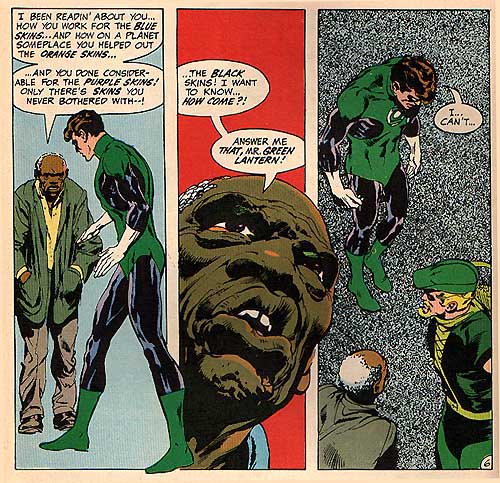
            Green Lantern has always had some racially provocative storylines thanks to Neal Adams, who put the very 1950s conservative minded GL alongside ultra-hippie Green Arrow which allowed for a lot of political discussion and some pretty incredible issues, including the introduction of African-American Green Lantern John Stewart and this fantastic panel.


            Still, there is not a lot of diversity in comics. Part of the fact is that these characters have been around since the 30s. The first mainstream black superhero was Black Panther. Before him there were black supporting characters, like the Spirits woefully racist caricature of a sidekick, but no real black badasses like Black Panther. He fought the KKK, Apartheid, and Doctor Doom.

            Asians are no longer regulated to the mystic sorcerer role, or do something involving katanas (like that one Outsider, Katana). It’s a step up from the Fu Man Chu-esque Iron Man villain literally called the Mandarin. The Atom is chinese, and Grant Morrison introduced two Japanese superhero squads known as Big Science Action and Super Young Team in Final Crisis who were just awesome in general.

            Hispanics are sort of new to the scene, with a surprising few in the mainstream outside of Blue Beetle and the Question. In researching this (read: looking up lists of Hispanic superheroes on Wikipedia) I was rather surprised to find out the Kyle Rayner counts because he is Half-hispanic Half Irish. I imagine we will se a rise in both Middle Eastern and Hispanic superheroes soon as the demographics continue to change, but I think there is a bigger problem at play here than just having these characters on hand.

            One of the reasons characters like John Stewart, Luke Cage, or Black Panther work is because they are badasses. A lot of times, comic companies will add “diversity hires” to the JLA or Avengers and then not really know what to do with them. To me, this is worse than not having anyone at all. Just sort of sticking someone in because the your super team wasn’t filling some sort of 501c3 requirement (I imagine the X-men do not pay taxes) is sort of missing the point.
            I really like Grant Morrison’s decision to use an Algerian immigrant for the Batman of Paris. There is still a general lack of Muslims in the multiverse, and this was a major step forward. The reason this works isn’t just because it’s a nice addition of diversity, but because the dude was awesome. It also worked well with the racial tensions currently plaguing France. It was a really solid call on their part, and that’s the kind of thing I applaud.

            When you look at the covers of most comics today, it does seem like they’re still sort of stuck in the Leave it to Beaver era of American entertainment where everyone is incredibly white. The problem is that is not what America looks like any more. We’re a pretty diverse country, and our heroes need to reflect that. I’m not saying we should up and make Superman and Wonder Woman black (besides, Grant Morrison did it in Final Crisis. They were supposed to be Barack and Michelle Obama.), but it wouldn’t hurt to consider bringing more diversity to the forefront in the interest of story rather than headlines. As fun as it is to make One Million Moms go crazy because Nova is going to marry his boyfriend, how about giving Nova a storyline that doesn’t just revolve around him being different. Batwoman has handled that really well, and I think a lot of other books that could take example from that idea of “yes, she’s a lesbian, now lets move on and watch as punches some dude in the teeth”.

            The best example of how diversity has been handled is with Jewish Characters. I think part of this has to do with half the people who write comics are Members of the Tribe, but the way they’re handled is really, really good. We get some big names, including Magneto, Shadowcat, Iceman, the everlovin’ blue-eyed thing, and the aforementioned Batwoman. These characters not only get storylines where their Judaism is the subject, but they also are allowed to develop far beyond that as actual characters who do things and are awesome in their own right.

            That’s what I’d really like to see. Lets have more ass-kicking as less trying to get articles in USA Today. Nobody reads it anyway, and having an Arab-American or homosexual Green Lantern doesn’t have any impact if you just do one story on how he is Arab-American or homosexual and then immediately go back to writing about Hal Jordan. Give them their own titles and see what you can do with them beyond sticking them in the background. If you want to really promote diversity and the American way (I think Superman would have something to say about that), let them actually do something.